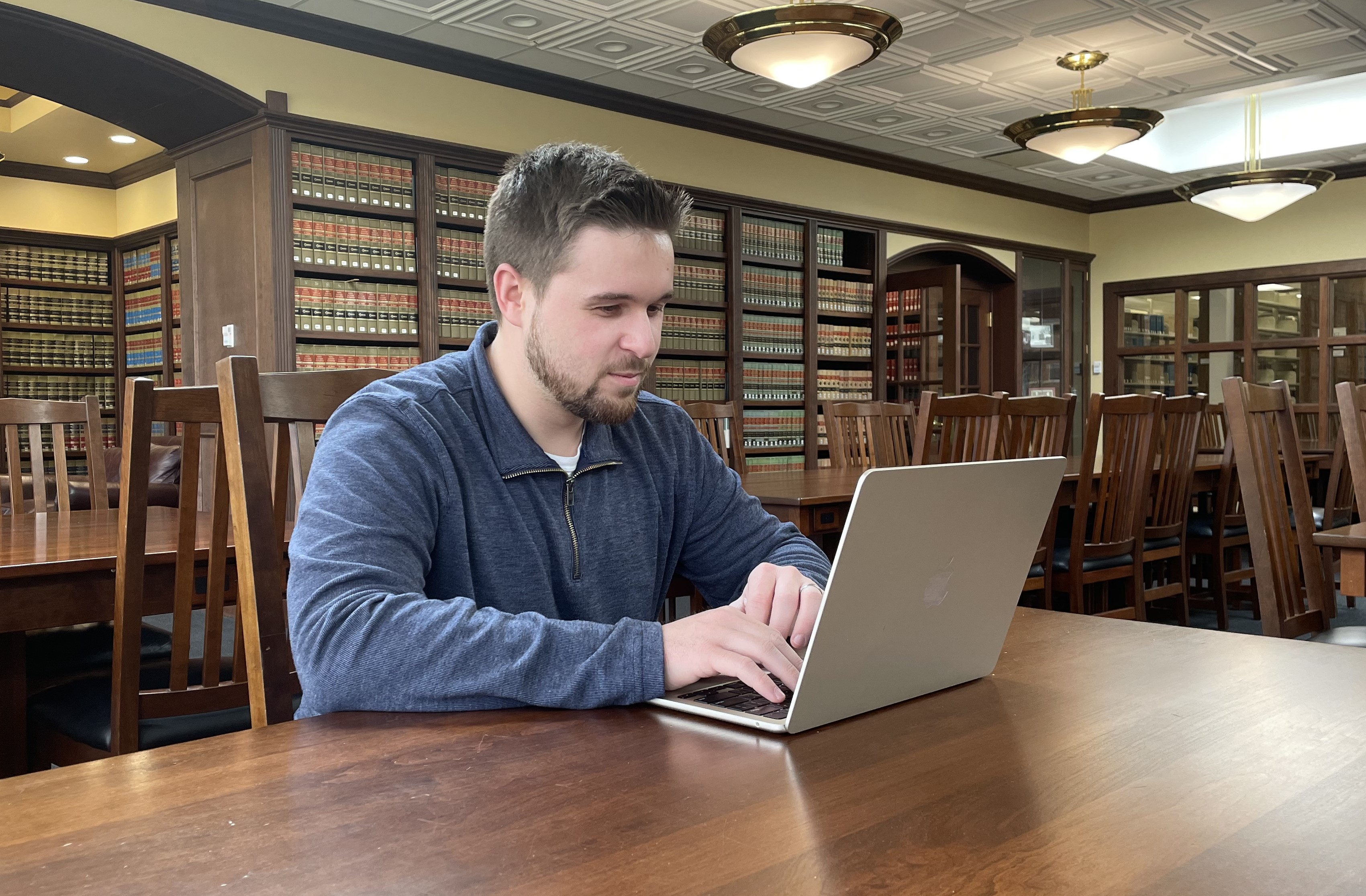
Third-year law student Blake Bailey recently attended the annual conference hosted by the Center on Law, Ethics and National Security (LENS) at Duke University, gaining firsthand insight into some of the most pressing national security law issues facing the United States today.
The conference, which brought together experts from government, military, federal agencies, academia and the private sector proved to be especially timely - coinciding with heightened U.S. engagement in Iran and a rapidly evolving conflict in the Middle East that has raised significant legal and policy questions for American leaders and military officials.
Bailey studies National Security Law under Professor Daniel Maurer at Ohio Northern University’s Pettit College of Law. He said Maurer’s class gave him the framework he needed to better understand the conference discussions, allowing him to engage more deeply with the complex legal issues presented. “I felt well prepared,” Bailey said. “At the same time, hearing those issues debated in a real-world context at the conference gave me a new perspective that I was able to bring back to the classroom, which made Professor Maurer’s lessons resonate even more.”
Maurer emphasized the value of opportunities like the LENS conference for law students. He explained that academic conferences like LENS are especially important when they invite thoughtful student participation.
According to Maurer, these conferences help expose law students to leading scholars and practitioners in national security law. He noted that these experts bring diverse perspectives from across the country.
Maurer added that such exposure helps students think about and address real-world challenges. These include issues like the war in Iran, the domestic deployment of troops to support federal law enforcement, responses to civil unrest, the Insurrection Act, and the laws of war.
“That exposure complements and accelerates the students' in-class learning from casebooks, and offers an additional benefit: networking with students from around the country with similar interests and with practitioners in and out of government.”
For Bailey, the conference served as both an academic and professional milestone—bridging classroom learning with the real-world legal challenges shaping national security policy today.